Posts

Gia-fu Feng: Personal Cultivation and Community Building

Image
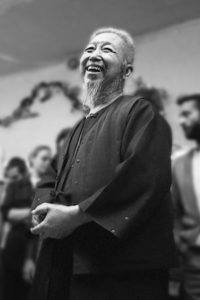
"Move as slowly as possible, as lightly as possible, as if drawing on sil. Be tranquil like a mountain. Be alert like a cat watching a mouse. Be natural like a hawk catching a rabbit. Most of all, be aware of the flow within and without." Gia-fu Feng in 'Tai Chi - A Way of Centering & I Ching. 1970. Collier Books. One of my ongoing interests is the evolution of Taijiquan through the generations - partly why I chose the name 'Echoes of Taijiquan' - together with the transmission, development, and spread of Taijiquan outside of China. In the case of the spread of Taijiquan, I’m specifically interested in how it got to the US and UK, and there are some well known names associated with this process in the US (Cheng Man-ch'ing, T. T. Liang, and William C. C. Chen amongst others). I've only relatively recently come across the name of Gia-fu Feng (b.1919 Shanghai, d.1985 Colorado) and largely due to his translation of classic Chinese texts such as the Dao De ...

The Daoyin Tu

Image
The Daoyin Tu (Guiding and Stretching Chart). Between 1972-74, during exacavations at the Mawangdui (King Ma's Mound) Tombs in Changsha, Hunan Province, a silk painting now known as the Daoyin Tu was discovered. The painting was found in the tomb of Xin Zhui (Tomb 1), the wife of Chancellor Li Cang who was also buried at the site in Tomb 2. Dated to the end of the 3rd century BCE, the Daoyin Tu is believed to be one of the earliest depictions of 'health movements' - ancestors of modern qigong - and shows around 40 postures, animal movements, and gymnastic movements aimed at treating pain and improving health. In addition to the Daoyin Tu, a wealth of other silk documents were found in the third tomb at the site. This tomb contained the burial of the son of Xin Zhui and Li Cang and included very early versions of the Dao De Jing, I Ching, and Zhan Guo Ce. [Credit: Daoyin tu - chart for leading and guiding people in exercise for improving health and treatment of pain, contain...

Intent

Image
 Intent. In a number of places the Classics talk about 'where' movement occurs first (translations: Barbara Davis): "first in the xin [heart-mind], then in the body" and "xin is the commander". (Wu Yuxiang, 'Exposition of Insights into the Thirteen Postures'.). "In all these cases, it is yi [intent], and not from externalities." ('Taijiquan jing'.) "Yi and qi are the lord, the bones and flesh are the subjects." ('Shisan shi ge'/'Thirteen Postures Song'.) This got me thinking about the process and the relationship between Xin (心, heart-mind) and Yi (意, Intention). Fortunately there's a fairly succinct explanation offered by Chen Yan-ling's (1943) 'Taiji Compiled: Boxing, Saber, Sword, Pole and Sparring' (Ch.5: On Intention and Energy): "As for intention, some say the intention is the same as mind and mind is the same as intention, but there is actually a slight distinction between mind a...

Smoke over the hill indicates fire, horns over the fence indicate an ox.

Image
 "Smoke over the hill indicates fire, horns over the fence indicate an ox. Given one corner, you grasp the other three; one glance, and you discern the smallest difference. Such quickness, however, is only too common among robed monks." Engo's Introduction to Case 1: Emperor Wu Asks Bodhidharma. Hekiganroku. Translated by Katsuki Sekida (1977) 'Two Zen Classics'. This struck a chord with me. How often do I go through my forms working towards the next movement rather than focussing on the one at hand? 'Grasping the other three' rather than 'being present'. [Image: Emperor Wu of Liang]

Your body, with awareness of its different parts, all comes together...

Image
 "Your body, with awareness of its different parts, all comes together as a center in moving circular motion. All the different movements of the tai ji chuan are variations of this flowing circular movement. Sometimes it is a small circle, sometimes it is large, sometimes the circle becomes a long elliptical curve, returning back in a double loop like a figure eight." Chungliang Al Huang in 'Embrace Tiger, Return to Mountain: Essence of T'ai Chi' (1988, 30) [Image: Chungliang Al Huang]

Do not be afraid to work.

Image
 “Do not be afraid to work. If you are afraid of hard work, you have no hope of making progress. The “Tai-chi ch’uan Classics” say that, “the root is in the feet.” If one is afraid of hard work, the feet will never develop root. This is why there is no doubt that working the feet hard is beneficial to the heart and brain.” ‘Cheng Man-Ch’ing’s Advanced T’ai-Chi Form Instructions’, compiled and translated by Douglas Wile (1985), pp.23-4. [Image: Cheng Man Ching, from Cook Ding’s Kitchen blog: https://cookdingskitchen.blogspot.com/2017/05/cheng-man-ching-biography.html]

This is the only way to practice T'ai Chi.

Image
 “This is the only way to practice T'ai Chi. If you have nothing in your mind in which to base your practice, your forms will gradually and unconsciously change. The functional uses of T'ai Chi will eventually be lost. Prof. Cheng Man Ch’ing told us this often. He said, 'When practicing T'ai Chi alone, you must imagine that there is an opponent in front of you. This is one of the secret techniques I learned from the Yang family.' It is very important that you do this."  T. T. Liang, in 'Steal My Art: The Life and Times of T'ai Chi Master, T. T. Liang' (Stuart Alve Olson, 2002) How are you all coping with lockdown? My form practice has increased massively but I'm missing push hands and application practice! Keep safe. [Image: Cheng Man-ching and T. T. Liang, from https://sanctuaryoftao.org/]

One of the best images for tai ji is nature, and the movement of nature.

Image
 "One of the best images for tai ji is nature, and the movement of nature. The different branches on the same tree do not move the same but they are moving in unity. When you look at nature, everything has its own motion: the tree and the rock and the water running - they somehow tie together without making a point to fit. When you watch the waves coming over the rocks, you see that the wave has wave-nature, rock has rock-nature. They do not violate each other's nature. That's a Tao concept, a Zen concept that exactly fits into tai ji practice." Chungliang Al Huang in 'Embrace Tiger, Return to Mountain: Essence of T'ai Chi' (1988) [Image: Chungliang Al Huang]

You must relax and eradicate every thought of using force.

Image
"You must relax and eradicate every thought of using force. If you are not relaxed, you are crooked. If you are crooked, you are using force. We must learn to be tender, soft, and peaceful." Liu Xiheng, quoted in Mason, R et al (2010) 'Liu Xiheng: Memories of a Taiji Sage'. Journal of Asian Martial Arts 19(2), pp72-107. 

Continuing the theme of teaching...

Image
Continuing the theme of teaching - and non-Taiji posts - I came across this in something that I'm currently reading. "Being a coach is not about swagger or bravado. It's not just about how well you can play or the knowledge and information you have accrued, it's about how you communicate it to your player and tailor it to their needs. And it's about your passion, commitment and emotional resilience."  While the (martial) skill of many past Taiji greats is often discussed it's less apparent how well they conveyed their skills to the next generation and in some cases (notably Yang Shaohou) they were clearly not sympathetic teachers. [Image: Cheng Man-ching and ???]

What do you do outside of your Taiji practice

Image
 What do you do outside of your Taiji practice? Does your practice extend into these activities and/or vice versa? A couple of chance encounters over the last few months have highlighted the non-Taiji aspects of well known Taiji practitioners. It was well known that Cheng Man-ching was regarded as 'Master of Five Excellences' - and some extend this to seven - including calligraphy, painting, medicine, poetry, and philosophy. But did you know that Ken Van Sickle, one of Cheng's early students, is an accomplished photographer, the Wall Street Times running a piece on him earlier this month: https://www.nytimes.com/2019/01/03/lens/ken-van-sickle-photos-bohemian.html Ed Young, also an early student of Cheng's, is an award-winning children's author and illustrator. Just two examples but I'd be surprised if there weren't more out there. Is there scope for such creativity within Taiji practice or does the repetition, focus, and precision of practice stimulate other...

One must distinguish the teacher from the taught.

Image
 "One must distinguish the teacher from the taught. ...And the fact that some of Zheng's students do postures one way does not mean Zheng taught them that way. Isn't it just possible that Zheng's teachings involved no changes, but instead simply reflects that he was superb at not changing Yang's system, teaching it as he had learned it? Zheng stressed accuracy first and last. When he learned the rudiments under Yang, he had to master each posture before moving to the next, there was no breezy form class followed by a corrections class. With time, his own form became less energetic and more internalized - compare his 1960 Taiwan film with his 1973 film - but his teaching remained pretty much the same." 'Zheng Manqing and Taijiquan: A Clarification of Role' by Robert W. Smith, Journal of Asian Martial Arts, Vol. 4 No. 1 (1995). [Image: Cheng Man-ching]

By not using qi, I follow the flow...

Image
 "By not using qi, I follow the flow, while the other goes against the flow. One has only to follow, then softly yield. The way that softness subdues hardness is gradual, while the way hardness subdues softness is abrupt. Abruptness is easy to detect, and so it is easily defeated. It is more difficult to sense gradualness, so it often prevails. This notion of not using qi is the extreme of softness. Only the extreme of softness can produce the extreme hardness." Cheng Man-ching's Foreward to Yang Cheng-fu's 'The Essence and Applications of Taijiquan' (Taijiquan Tiyong Quanshu), p.2 (Louis Swaim translation). [Image: Yang Cheng-fu (back seat) with Zhao Bin (right) and Zhou Tien Sou Lin (centre). http://qi-encyclopedia.com]

Conscientiously remember the four words...

Image
 "Conscientiously remember the four words: losing contact, butting, belligerence and separation. If your art can be free of over-anxiousness and separation, you will be able to perform marvels with your hands." Wang Tsung-yueh's Treatise on T'ai-chi ch'uan in Yang Ch'eng -fu's Self Defense Applications of T'ai Chi Ch'uan (Douglas Wile translation). [Image: Yang Shouzhong and Ip Tai Tak]

Those who possess inner principle without outer technique...

Image
"Those who possess inner principle without outer technique, who think only of the arts as quietism and know nothing of the practise of combat, are lost as soon as they commit the slightest error. Whether for practical pursuits or simply the way of being a human being, how dare we neglect the two words - civil and martial?" 'The Meaning of Civil and Martial in T'ai Chi', Yang Family Manuscripts Copied by Shen Chia-chen in Douglas Wile 'T'ai-chi Touchstones: Yang Family Secret Transmissions', p.87. [Image: Wu Jianquan]  

Good advice for beginners...

Image
 Good advice for beginners: “At the beginning of study do not speak of training the ch’i, but first develop your body, footwork, and eye techniques. It is also important not to use strength, but rather execute each posture naturally and slowly in circular dance-like movements. Coordinate the whole body into a unified whole, and then cause it to be light, lively, and perfect. Wherever there is stiffness and awkwardness release these one by one according to the postures. As you perform each posture, relax and open all the joints in the body. In this way, you will reach a marvellous level.” Ch’ang Nai-chou’s Writings, translated in Douglas Wile ‘Tai Chi’s Ancestors’, p.129 [Image: Tung Ying Chieh in Single Whip]

The application of chi and energy (chin) in T’ai-chi ch’uan is slow and continuous...

Image
 “The application of chi and energy (chin) in T’ai-chi ch’uan is slow and continuous, cyclical and repetitious, circular and interconnected. It is inexhaustible." “While its surface is expansive, its center is cohesive, and therefore it does not lose its roundness.” “It takes roundness as a model, but it is not really a sphere. Its defense is based on the principle of roundness; its offense is to be everywhere triangles.” Cheng Man-ch'ing 'Master Cheng’s Thirteen Chapters On T’ai Chi Ch’uan', ch.7

The Guideline, Yi Shou Dantian, points your mind to a central location in your body...

Image
 "The Guideline, Yi Shou Dantian, points your mind to a central location in your body - the Lower Dantian. The literal meaning of the word "Shou" is to keep or to guard. It implies "guarding" your mind and Qi to maintain their "integrity  and unity" in your Dantian area. Thus preventing the scattering of your thoughts and Qi, in order to achieve harmony - Mind and Qi Connected (Yi Qi Xianglian)". Shou-Yu Liang & Wen-Ching Wu in 'Tai Chi Chuan. 24 & 48 Postures with Martial Applications', p.20 [Image: Grandmaster Shou-Yu Liang, from http://www.shouyuliang.com]

The ch’i is like a wheel, and the whole body must mutually coordinate.

Image
 “The ch’i is like a wheel, and the whole body must mutually coordinate. If there is any uncoordinated place, the body becomes disordered and weak. The defect is to be found in the waist and legs.” Five Character Secret by Li I-yu, translated in Lo et al ‘The Essence of T’ai Chi Ch’uan’, p.74

Expand and fill it. This applies to every posture.

Image
 “Expand and fill it. This applies to every posture. To sum up, the ch’i lands on one point, but it comes from many sources. If you open the source and free the flow, the path will be smooth and you will naturally avoid halting, dragging, and impediment.” Ch’ang Nai-chou’s Writings, translated in Douglas Wile ‘Tai Chi’s Ancestors’, p.94. [Photo: Tung Ying Chieh in 'Snake Creeps Down' posture]